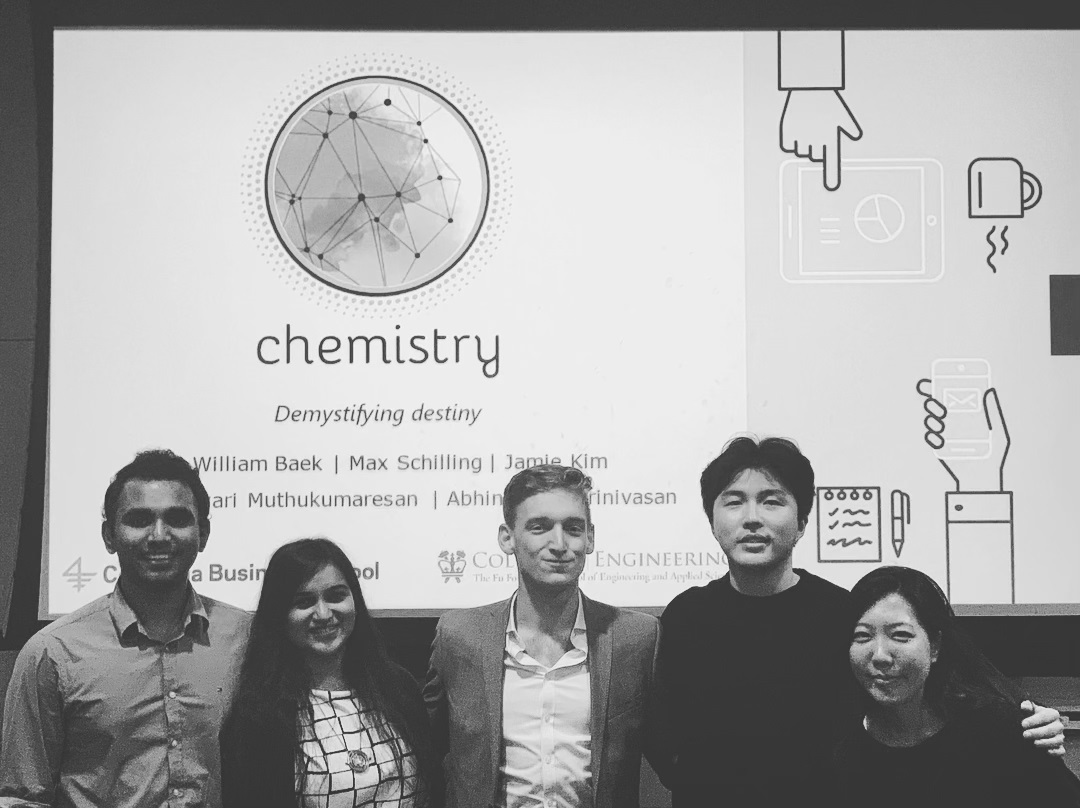
Columbia Business School and SEAS co-hosted their first Media Hackathon, bringing together students from across the university to pitch media and tech products in 24 hours. Our team — William Baek, Jamie Kim, and Maxwell Schilling from CBS, and Vigneswari M and I from SEAS — won 1st place in the Media category.
The Idea: Chemistry
We built Chemistry — a dating app aimed at South Asian and East Asian women in their mid-20s to early-30s who are looking for serious relationships, not just casual matches. The core insight was that existing dating apps felt culturally misaligned for this demographic: too casual, lacking privacy controls, and disconnected from community norms around matchmaking.
Our tagline: Demystifying destiny.
The Matching Algorithm
The differentiator was a fortune-telling-inspired matching algorithm — leaning into the cultural familiarity with astrology and destiny-based compatibility rather than fighting it. The idea was to wrap a data-driven compatibility engine in a narrative that felt familiar and trustworthy to the target user.
What We Built Around It
Beyond the algorithm hook, we designed the product around three real pain points:
- Safety: Automatic message scanning to flag and prompt reporting of suspicious behavior, plus a no-show reporting feature for ghost dates.
- Privacy: Age shown as a range, first-name-only display, and two-way confirmation before direct messaging.
- Trust: Identity verification through Facebook, first-degree-of-separation filtering, and phone number verification.
Market Framing
We positioned Chemistry at the intersection of the $36B mystical services market and the $12B online dating market — both growing, and almost entirely untouched by the same product. The go-to-market was tight: a specific, underserved user who was already spending in both categories.
Takeaway
The cross-school collaboration was the real win. Having CBS teammates who could think through business model, user acquisition, and pitch narrative alongside SEAS engineers who could speak to technical feasibility made the pitch feel complete. It was a good reminder that the best hackathon teams aren't the most homogeneous — they're the most complementary.